Car dealerships get the most from mobile billboards when the ad points to something happening now: a weekend sales event, a model-year clearance, a new model that just arrived on the lot or a service special with an end date. An LED truck can run through the neighborhoods in your market area during the week, then park near the dealership on Saturday with the screen raised and the sound on, so the people who saw it on the road can find you. What doesn’t work is a generic “Best deals in town” spot with no date and no offer behind it.
Below are the campaigns that suit a truck, how to plan routes around the sales data you already have, what to put on the screen and the pricing rules that follow your ad onto it.
Where a Truck Fits in a Dealership’s Marketing Mix
Most dealers already spend on search, social, third-party listing sites, radio and static billboards. A truck doesn’t replace any of them. It fills a specific gap: putting a time-limited message in front of local drivers, in the areas where you want more buyers, in the days right before you need them on the lot.
That timing matters because a car purchase starts long before the showroom. Shoppers compare inventory online for weeks, then pick a few dealers to visit. A truck that keeps your name and your event in front of them during that window helps you make the short list. It also helps your digital budget: people who saw the truck search for your dealership by name, and branded searches are usually cheaper to win than generic model searches.
Six Dealership Campaigns That Work on a Mobile Billboard
1. Weekend sales events
The classic use. Run the truck Thursday through Saturday on the main roads and neighborhoods in your market area, then park it near the dealership during the event. The message is simple: event name, dates, one headline offer.
2. Model-year clearance
When next year’s models start arriving, outgoing inventory has to move. A clearance message with a clear deadline (“Outgoing models, limited stock, ends Sunday”) gives people a reason to come in now. Update the screen as units sell so you never advertise a car that is already gone.
3. New model launches
A new or redesigned model is one of the few moments when people actually want to see a car before they need one. Video of the vehicle on the side screens, “Test drive it this weekend” and a QR code to book on the rear screen. Shopping centers, business districts and local events are good stops. More on launch campaigns in trade shows and product launches with LED trucks.
4. Holiday sales
Presidents Day, Memorial Day, the Fourth of July, Labor Day, Black Friday and year-end are traditional sales weekends in the auto business, which also means every competitor is advertising at the same time. A truck running the week before each holiday weekend helps your event stand out from the radio and TV noise. See seasonal marketing with mobile billboards for more ideas.
5. Service and parts specials
The service department keeps customers coming back between purchases. Seasonal offers work best: AC checks before summer in Texas, Florida and Arizona, tires and batteries before winter elsewhere. Route the truck through the ZIP codes where your existing service customers live, with one offer, one price and one expiry date.
6. Hiring technicians and salespeople
Dealers compete hard for qualified technicians. A “Now hiring techs” message with pay or a sign-on bonus and a QR code to apply, run around trade schools and industrial areas on weekday mornings, reaches people who aren’t scrolling job boards. Our guide to recruiting with mobile billboards covers this in detail.
| Campaign | When to run | Route | Screen message |
|---|---|---|---|
| Weekend sales event | Thursday to Saturday | Main roads and neighborhoods in your market area, then parked near the dealership on Saturday | Event name, dates, one headline offer |
| Model-year clearance | When new model-year inventory arrives | Suburbs and corridors where competitors are strong | “Outgoing models, limited stock,” vehicle image, deadline |
| New model launch | Launch week and the weekend after | Shopping centers, business districts, local events | Vehicle video, “Test drive it this weekend,” QR code to book |
| Holiday sales | The week before each holiday weekend | Broad metro coverage | Holiday event name and dates |
| Service specials | Before seasonal peaks | ZIP codes where your service customers live | One service offer, price, expiry date |
| Technician hiring | Weekday mornings, any month | Trade schools, industrial areas | “Now hiring techs,” pay or bonus, QR code to apply |
Plan Routes Around Your Own Sales Data
Dealers have an advantage most advertisers don’t: they know exactly where their buyers live. Your DMS and CRM show sales and service customers by ZIP code, and many manufacturers assign each store a primary market area. Use that data to draw the route instead of guessing.
- Defend: ZIP codes where you already sell well. Service specials and loyalty offers fit here.
- Grow: ZIP codes inside your market area where you underperform. Sales events and clearance offers fit here.
- Connect: the main commuter roads between those neighborhoods and your lot.
A truck covers a lot of ground in a shift (see how far a mobile billboard truck travels in a day), but for dealers two or three tight loops repeated through the day usually beat one long route. People need to see an event message more than once before it sticks. For timing, see the best time of day to run a mobile billboard campaign.
Turn the Truck Into a Saturday Landmark
Parked on or near the lot, wherever local rules allow, with the screen raised 10 feet, the truck becomes something drivers notice from the main road. Both sides of our trucks have a powerful audio system, so you can add sound during event hours if local noise rules permit it. Combined with the usual event setup (tents, flags, a food truck), it makes your sale visible from the intersection, not just from the lot.
Some cities regulate where advertising vehicles can park or operate. Check before the event, using our overview of mobile billboard permit rules as a starting point.
What to Put on the Screen
| ❌ Weak on a truck | ✅ Works on a truck |
|---|---|
| Five vehicles with five prices on one screen | One vehicle and one offer per spot, rotated through the loop |
| “Huge savings! Best deals!” | A specific offer with a real number and an end date |
| Disclosures shrunk until nobody can read them | Disclosures on their own frame, held long enough to read, or a simpler offer that needs fewer of them |
| A 10-digit phone number | A short web address or QR code that opens the exact inventory page |
| The same spot all month while units sell | Messages updated as inventory changes |
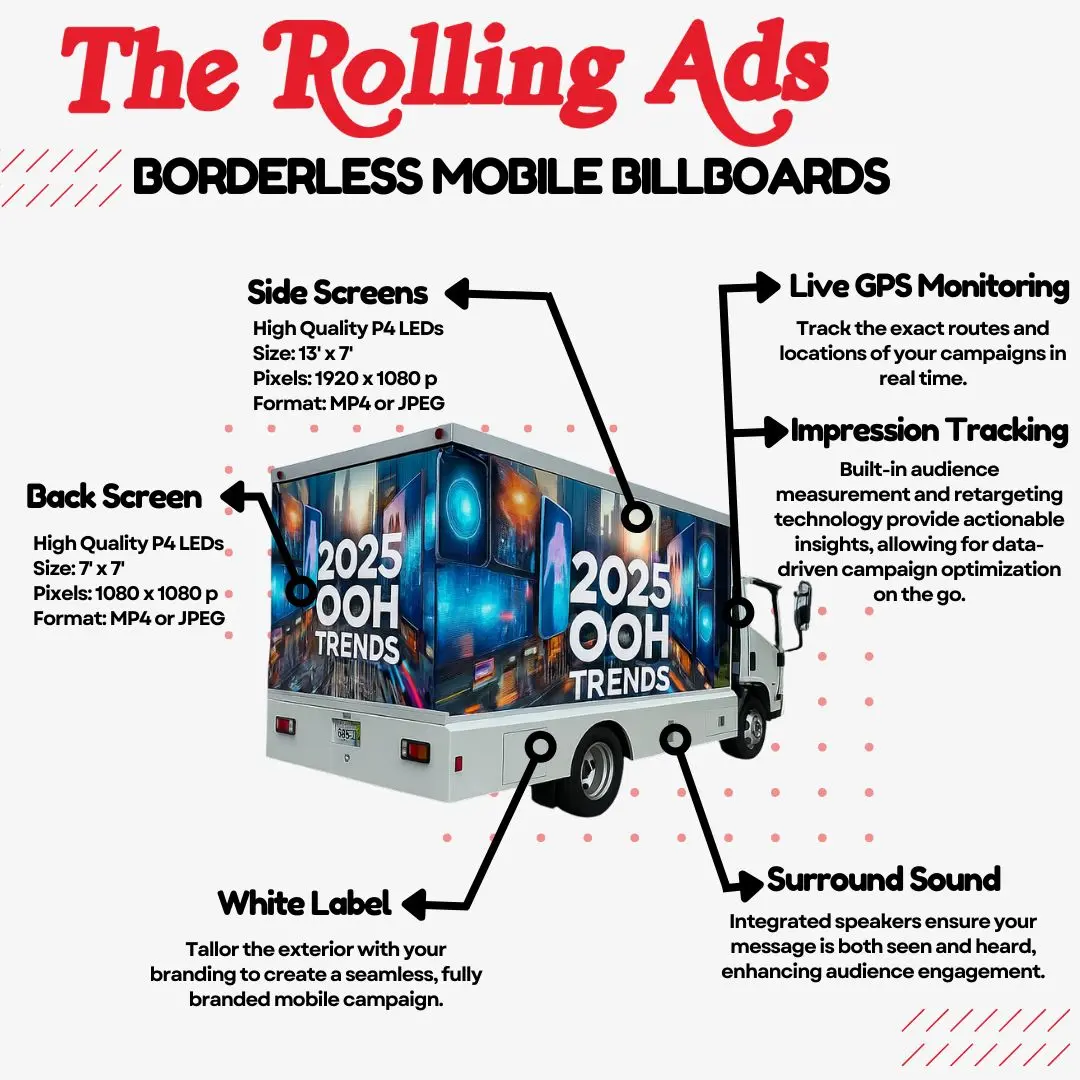
Cars sell on looks, so video does more here than for most products: a slow 360-degree turn or a short driving clip catches the eye better than a still photo. The Rolling Ads trucks run P4 LED screens on three sides with unlimited ad changes, so you can show the vehicle on the sides, keep the call to action on the rear screen and swap creative the moment a unit sells. More design basics in tips for high-converting mobile billboard ads.
Pricing Rules Still Apply on a Moving Screen
Auto advertising is one of the most closely regulated categories, and the rules follow your ad onto the truck.
- Federal rules: the FTC has repeatedly warned dealers that an advertised price must include all mandatory fees, with only government charges such as taxes and registration excluded. Its guidance applies to roadside signs as well as online and print ads.
- State rules: requirements vary. New York’s guidance calls for a statement next to the price about excluded fees and taxes and a disclosure when a vehicle isn’t in stock. Oklahoma requires the stock number when a single vehicle is advertised. Ohio requires used vehicles to be clearly labeled as used.
- Keep it current: if an advertised unit sells, take it off the screen the same day. On an LED truck that is a quick update, not a reprint.
- Manufacturer co-op: many manufacturers reimburse part of dealer advertising through co-op programs, but eligible media, brand guidelines and pre-approval rules differ. Check whether mobile billboards qualify under your program before you book, and get creative approved in advance if required.
This is a practical checklist, not legal advice. See also legal pitfalls to avoid with LED billboard campaigns.
Measure What the Truck Delivered
- Dedicated landing page: send the QR code and short URL to a page built for the event, not your homepage. Dynamic QR codes come with our service free of charge and show scans in real time.
- CRM lead source: add “Mobile billboard” as a source and ask at the desk how each customer heard about the event.
- Event-day comparison: compare showroom traffic, appointments and sales with similar weekends when the truck didn’t run.
- Route overlay: line up the truck’s GPS route history with the ZIP codes of new leads, and read the impressions report alongside it.
For a full tracking setup, see how to track the ROI of a mobile billboard campaign.
Book a Truck for Your Next Sales Event
Cost depends on the market, the number of hours and the number of days. Our 2026 mobile billboard pricing guide explains the main factors. A good first test is one weekend sales event: three days of routes in your market area and the truck parked at the dealership on Saturday.
The Rolling Ads runs LED truck campaigns in Florida, Texas, California, Arizona, Las Vegas, Philadelphia, New York and other markets. Send us your event dates and market area, and we’ll suggest a route.
Frequently Asked Questions
Do mobile billboards work for car dealerships?
Yes, especially for time-limited messages such as weekend sales events, model-year clearance, new model launches and service specials, when the route covers the dealership’s market area.
Can the truck park at my dealership during a sales event?
Usually, as long as local parking and advertising vehicle rules allow it. With the screen raised 10 feet, the truck works as a landmark that drivers can see from the main road.
Do dealership ads on a mobile billboard need price disclosures?
Yes. Federal and state auto advertising rules apply to every medium. Advertised prices must include mandatory dealer fees, and many states add their own disclosure requirements.
Can mobile billboard advertising qualify for manufacturer co-op funds?
It depends on the manufacturer. Co-op programs differ in eligible media and pre-approval rules, so check your program’s guidelines before booking.
How do I track sales from a mobile billboard?
Send a QR code or short URL to a dedicated landing page, add the truck as a lead source in your CRM, and compare event-day traffic and sales with similar weekends without the truck.
Partner with us to drive your brand forward with mobile billboard advertising on trucks. Contact us today to learn more about our services and how we can help elevate your advertising campaign.
Engage a wide audience instantly with captivating ads by leveraging the power of targeted location, the brightest screens on the market with video or static ads, even 3D immersive animation and sound.
We value your inbox as much as you do, so rest assured that we won't clutter it with unnecessary spam. You’ll only hear from us when we have relevant, valuable offers that we think you'll love.
(We do not share your data with anybody, and only use it for its intended purpose)