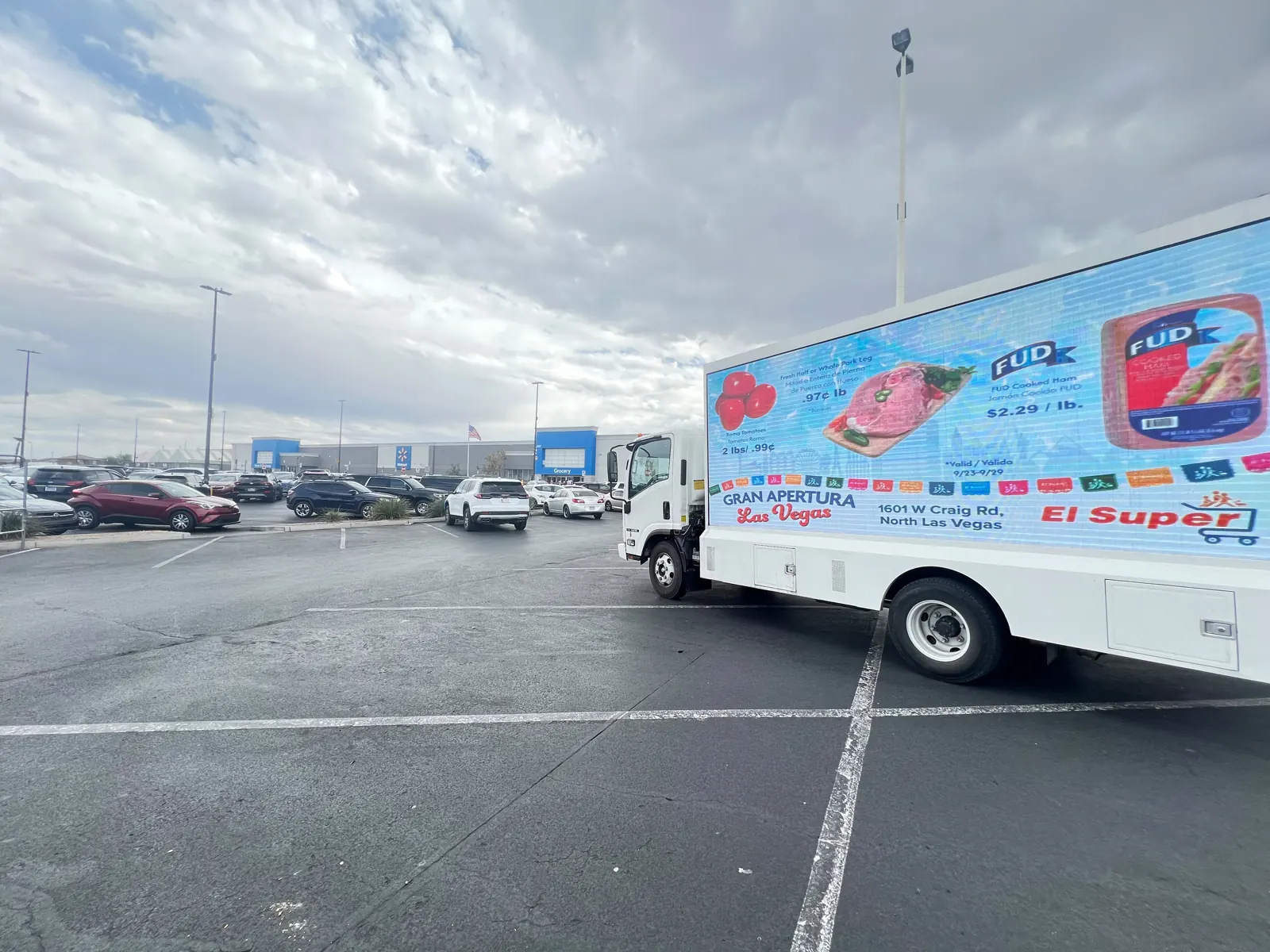
To reach Hispanic audiences with a mobile billboard, start with the neighborhood, not the language. A truck can run a Spanish version through Little Havana or East Los Angeles and switch to English or a bilingual version a few miles later, which makes it one of the few outdoor formats that can match the language to the street it’s on. The other half of the job is the copy: Spanish written for your local audience, not translated word for word from an English ad.
The audience is large in the markets where we run many of our campaigns. Census estimates put the Hispanic share of the population at about 70 percent in Miami-Dade County and close to half in Los Angeles County and Harris County (Houston), compared with about one in five people nationally. More than 40 million people in the US speak Spanish at home.
Spanish, English or Both? Match the Language to the Audience
“Hispanic audience” is not one audience. A recent arrival from Honduras in Houston, a third-generation Mexican American in Los Angeles and a bilingual Cuban American professional in Miami read ads differently. Pew Research has long found that many US-born Latinos are English-dominant or bilingual, while immigrants are more likely to prefer Spanish. Language choice should follow who actually lives and works along the route.
| Audience along the route | What usually works | Example |
|---|---|---|
| Mostly Spanish-dominant, many recent immigrants | Spanish only, short and direct | “Consulta gratis. Llame hoy.” |
| Younger, US-born, bilingual | English, or a natural mix of both languages | “Free consultation. Hablamos español.” |
| Mixed neighborhoods and general market areas | Rotate an English and a Spanish version in the same loop | English spot, then the Spanish spot with the same offer |
When in doubt, rotate. LED trucks with unlimited ad changes can alternate versions in the same loop or switch language as the truck moves from one neighborhood to the next, at no extra production cost beyond the second version of the artwork.
Write It in Local Spanish, Not Translated Spanish
Spanish varies by country of origin, and the differences show up in everyday words. “Camión” means bus in Mexico and truck in most other countries. “Guagua” is a bus in Cuba and Puerto Rico but a baby in Chile. A car can be a “carro,” a “coche” or an “auto,” depending on who’s reading. Miami’s Hispanic population includes large Cuban, Venezuelan, Colombian and Nicaraguan communities, while Mexican and Central American communities make up most of the Hispanic population in Los Angeles and Houston. Copy that sounds natural in one city can sound foreign in another.
| ❌ Common mistake | ✅ Better approach |
|---|---|
| Running the English slogan through a translation tool | Copy written or adapted by a native speaker from the community you’re targeting |
| The same Spanish ad in Miami and in Houston | Local word choices and references for each market |
| An English layout with Spanish text squeezed in | A layout designed for Spanish, which usually runs longer than English |
| “Hablamos español” on the truck, an English-only phone menu after the call | Spanish-speaking staff, or at least a Spanish option, when people call |
| Stereotyped imagery: sombreros, maracas, generic “fiesta” graphics | Real local people, places and references the audience recognizes |
| Required disclaimers only in English | Disclaimers in the same language as the ad |
The phone row deserves emphasis. If the ad promises Spanish, the person who answers has to deliver it. Nothing kills a campaign faster than a caller who responds to a Spanish ad and lands in an English-only voicemail.
Designing Spanish Copy for a Moving Screen
Drivers give any outdoor ad a few seconds, and Spanish makes that harder because the same message usually takes more words. Cut words, not font size. “Free estimates, same week” has to become something equally short in Spanish, not a full sentence.
- Check the accents. Make sure the font renders á, é, í, ó, ú, ü and ñ correctly. A missing tilde can turn a word into a different word entirely, and readers notice.
- Keep one call to action. A phone number, a short web address or a QR code. Not all three.
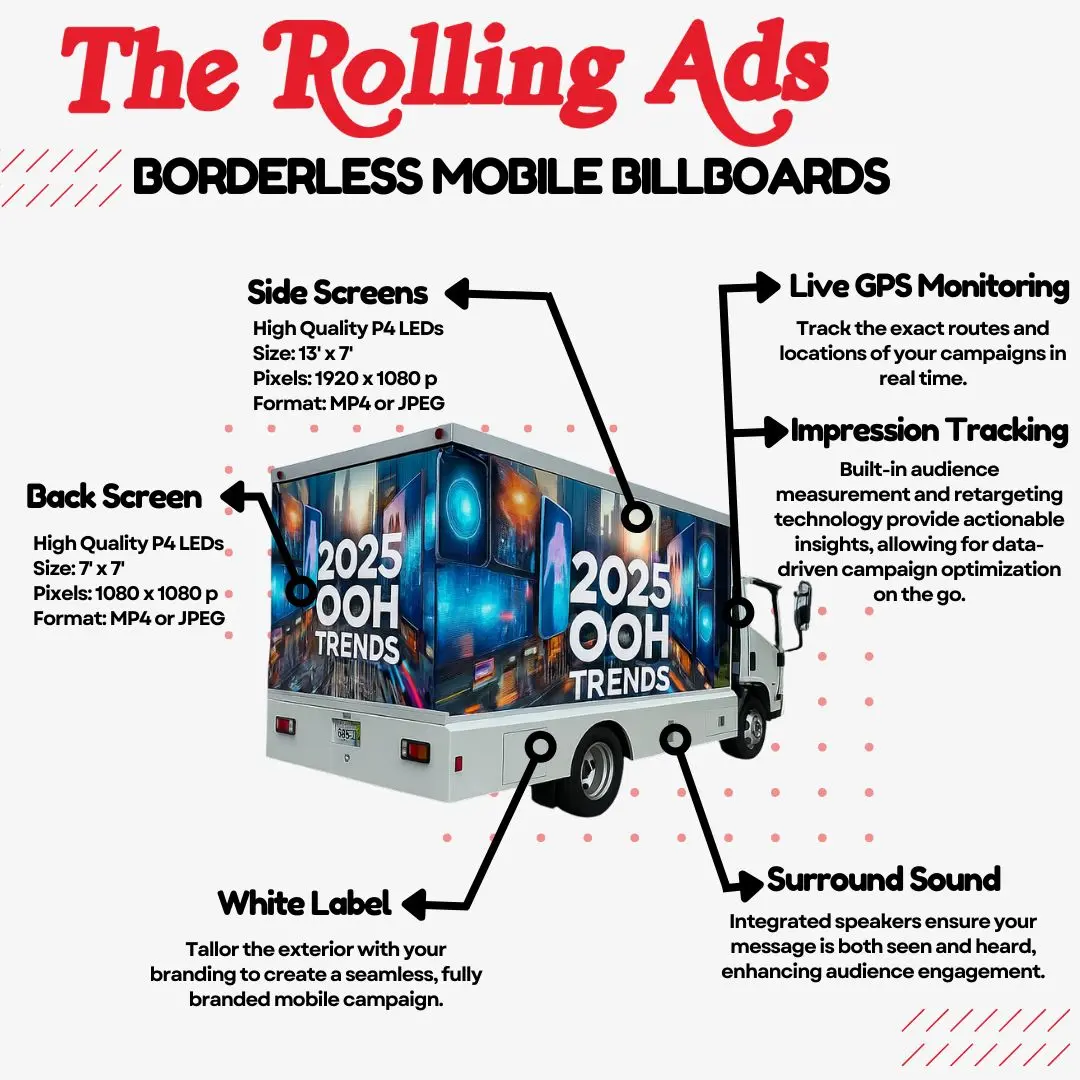
- Use the rear screen for details. Our trucks have P4 LED screens on three sides. The sides carry the headline; the rear screen, which drivers behind the truck can read at a light, carries the number or the QR code.
- Use sound at events. Both sides of the truck have a powerful audio system, so Spanish-language audio or music can work when the truck is parked at a festival or a community event.
For general design rules, see how to make drivers remember your ad after 5 seconds.
Where to Run the Truck: Miami, Houston, Los Angeles and Beyond
Miami
Little Havana and Calle Ocho, Hialeah, Doral (home to one of the largest Venezuelan communities in the US), Westchester and Kendall. Downtown and Brickell lean bilingual, so rotation works well there. See our Miami mobile billboard page for market details.
Houston
The East End, Gulfton, Pasadena and large parts of the north and southwest sides have strong Hispanic communities. Commuter corridors connecting them with downtown and the Energy Corridor reach working audiences at rush hour. More on our Houston page.
Los Angeles
East Los Angeles, Boyle Heights, Huntington Park, Pico-Union and much of the San Fernando Valley. Los Angeles is spread out, so a tight route through two or three neighborhoods usually beats a long drive across the county. See our Los Angeles page.
Other strong markets
We also run campaigns in El Paso, New Mexico, Arizona, Fresno and Austin, all with large Hispanic populations. For geo-targeting tactics, see geo-targeting with mobile billboards.
Dates That Matter to Hispanic Audiences
The general US calendar applies, but several dates carry extra weight, and some fall on different days than their US equivalents. Mexican Mother’s Day, for example, is always May 10, not the second Sunday of May.
| Date | When | Who celebrates it most | Good fit for |
|---|---|---|---|
| Día de Reyes | January 6 | Many Mexican, Cuban and Puerto Rican families | Bakeries, toy and gift retail |
| Día de las Madres | May 10 | Mexican, Guatemalan and Salvadoran families | Restaurants, florists, retail, money transfer services |
| Central American independence days | September 15 | Guatemalan, Honduran, Salvadoran, Nicaraguan and Costa Rican communities | Community events, restaurants |
| Mexican Independence Day | September 16 (celebrations start the night of the 15th) | Mexican communities | Event sponsorships, restaurants, grocery |
| Hispanic Heritage Month | September 15 to October 15 | Broad audience | Brand campaigns, community partnerships |
| Día de los Muertos | November 1 and 2 | Mexican communities | Cultural events and sponsorships, handled respectfully |
| Nochebuena | December 24 | Cuban and many other Latin American families | Grocers, butchers, restaurants, retail |
Big soccer matches are another reliable moment. When a national team or a popular club plays, sports bars and watch parties in Hispanic neighborhoods fill up, and a truck parked nearby with the screen raised 10 feet is hard to miss. For more on seasonal timing, see seasonal marketing with mobile billboards.
Compliance: Disclaimers Belong in the Same Language
If your industry requires disclaimers (legal services, financial products, healthcare, auto sales), plan for them in Spanish too. Some regulators expect disclosures in the language of the ad, and a disclaimer in a language the reader didn’t choose does little to inform them. In regulated industries, check whether a translated version counts as a separate ad that needs its own review. Our post on legal pitfalls in LED billboard campaigns covers the general risks.
How to Measure a Spanish-Language Campaign
- Separate QR codes for each language. Dynamic QR codes come with our service free of charge, so you can compare scans from the Spanish and English versions directly.
- A Spanish landing page. A Spanish QR code that opens an English page loses people in the first second.
- A separate phone line or menu option. Calls to the Spanish line tell you how the Spanish version performed.
- Route data by neighborhood. Live GPS tracking and route history show where each version ran, so you can match responses to neighborhoods.
For a full tracking setup, see how to track the ROI of a mobile billboard campaign.
Start With One Market and Two Versions
The simplest first campaign is one city, one route through two or three neighborhoods, and two versions of the same offer: one in English, one in Spanish written by a native speaker. Run them for a week, compare the QR scans and calls for each, and build the next campaign on what you learn. Our 2026 pricing guide explains what drives the cost.
Tell us your market and your audience, and The Rolling Ads team will help plan the route and the rotation.
Frequently Asked Questions
Should a mobile billboard be in Spanish or English for Hispanic audiences?
It depends on the neighborhood. Spanish works best for Spanish-dominant audiences, English or bilingual copy works for many US-born Latinos, and rotating both versions works well in mixed areas.
Can one truck show both Spanish and English ads?
Yes. An LED truck can rotate both versions in the same loop or switch languages as it moves between neighborhoods.
Is it enough to translate my English ad into Spanish?
Usually not. Word choices vary by country of origin and Spanish copy tends to run longer, so the ad should be written or adapted by a native speaker from the target community, with the layout adjusted to fit.
Which US cities have the largest Hispanic audiences for mobile billboard campaigns?
Among our markets, Miami-Dade County (about 70 percent Hispanic) stands out, followed by Los Angeles County and Harris County in Houston, where close to half of residents are Hispanic. El Paso, New Mexico, Arizona and Fresno are also strong.
What dates matter most for Hispanic marketing campaigns?
Hispanic Heritage Month (September 15 to October 15), Central American independence days (September 15), Mexican Independence Day (September 16), Día de los Muertos (November 1 and 2), Nochebuena (December 24), Día de Reyes (January 6) and Mexican Mother’s Day (May 10).
Partner with us to drive your brand forward with mobile billboard advertising on trucks. Contact us today to learn more about our services and how we can help elevate your advertising campaign.
Engage a wide audience instantly with captivating ads by leveraging the power of targeted location, the brightest screens on the market with video or static ads, even 3D immersive animation and sound.
We value your inbox as much as you do, so rest assured that we won't clutter it with unnecessary spam. You’ll only hear from us when we have relevant, valuable offers that we think you'll love.
(We do not share your data with anybody, and only use it for its intended purpose)